
Ankle Joint Surgery
Our feet are made up of 26 bones and more than 33 joints structured in rigid and flexible columns and arches.
What Is Ankle Joint Surgery?
Our feet are made up of 26 bones and more than 33 joints structured in rigid and flexible columns and arches.
The ankle joint, also known as the talocrural joint, is a synovial joint that joins the fibula and tibia bones of the leg to the talus of the foot. It's a complicated hinge joint with two articulations.
With the subtalar and midtarsal joints, the ankle joint allows for dorsiflexion and plantar flexion of the foot, as well as some pronation and supination. When the heel impacts the ground during the earliest phases of gait, the joint also acts as a shock absorber.
What causes broken ankle?
Sports
- Increasing the frequency or intensity of your exercise sessions suddenly, whether you're a professional athlete or someone who's just started exercising, can increase your chance of an ankle injury. You can suffer an injury by faulty equipment and by poor training tactics, such as not warming up and stretching.
Accidents
- Tripping and falling, as well as landing on your feet after jumping down from a short height, can shatter bones in your ankles. Crushing injuries, which are prevalent in car accidents, can result in fractures that requires surgery to fix.
Medical Conditions
- Having low bone density (osteoporosis) puts you at risk for ankle bone fractures.
When is a surgery recommended?
Ankle surgery may be required to repair fractures (broken bones), arthritis, tendonitis, and other issues that are not managed by oral medication. Milder fractures may not require surgical correction if the ankle is stabilized and the damaged bone is not out of place. An ankle fracture requires surgery if the bones in the ankle are fragile and require additional support to mend.
Types of surgery
The kind of surgery that is ideal for treating your damaged ankle is determined by the severity of the injury. The surgery are carried out under the influence of local anesthesia or general anesthesia
Ankle arthroscopy
Suggested for arthritis and ankle injuries, it is a minimally invasive procedure that involves surgeons removing fragments of bone or cartilage from the ankle with specific devices by creating tiny incisions in the ankle.
Ankle Tendon Surgery
A tiny incision is made above the tendon to perform tendon repair surgery. Surgeons will remove any damaged tissue with specialized surgical equipment. A tendon from another part of the body can be transplanted onto the injured tendon. This helps to heal and strengthen the weak tendon.
Ankle fracture surgery
To keep the shattered bone in place the doctor uses screws, metal plates, and small metal wires in surgery to stabilize the cracked bones in your ankle.
Ankle fusion
Surgeons remove damaged tissue of the ankle joint that are affected by arthritis. The ankle bones are then permanently fused together with screws and metal plates by surgeons.
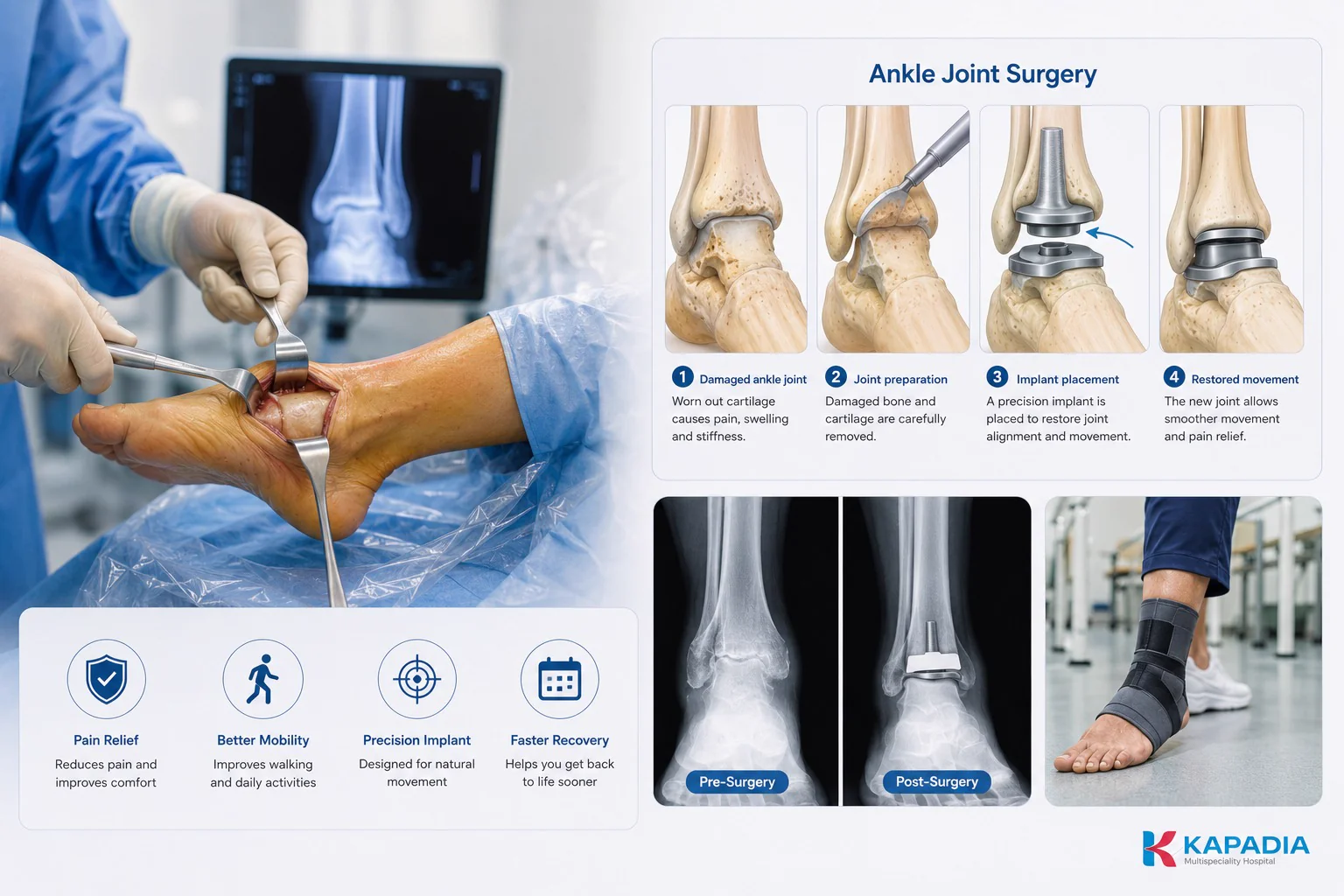
Ankle replacement
During ankle replacement surgery, the injured ankle joint is gently removed. They replace the injured joint with a plastic or metal prosthesis. Screws may be used by your surgeon to assist stabilize the ankle replacement.
Brostrom Surgery
The restoration of abnormally loose ligaments on the lateral or outside of the ankle as a result of recurrent ankle sprains. The anterior talofibular ligament is repaired or tightened in order to address ankle instability. Also known as lateral ankle ligament restoration.
What to expect post-surgery?
After your procedure, you may need to spend at least one night in the hospital. Your ankle will be immobilized with a cast or splint. You should anticipate to be on crutches for a while.
To manage your postoperative discomfort, you will be prescribed pain medications.
To help reduce swelling and discomfort, your ankle will be elevated on a cushion and ice packs will be put over the dressing.
Physical therapy (physiotherapy) will begin soon after surgery, and you will be taught specific exercises to help you regain full ankle range of motion.
The most advanced surgical technology and highly qualified surgeons are available to treat ankle joint injuries at Mumbai's Kapadia Hospital. Today, make your way to Kapadia Hospital for the greatest care and rehabilitation.
Frequently Asked Questions.
Quick answers about Ankle Joint Surgery at Kapadia Multispeciality Hospital, Goregaon West.
Ankle surgery may be required to repair fractures (broken bones), arthritis, tendonitis, and other issues that are not managed by oral medication. Milder fractures may not require surgical correction if the ankle is stabilized and the damaged bone is not out of place. An ankle fracture requires surgery if the bones in the ankle are fragile and require additional support to mend. Ankle conditions that may need surgery include:
The kind of surgery that is ideal for treating your damaged ankle is determined by the severity of the injury. The surgery are carried out under the influence of local anesthesia or general anesthesia
After your procedure, you may need to spend at least one night in the hospital. Your ankle will be immobilized with a cast or splint. You should anticipate to be on crutches for a while. To manage your postoperative discomfort, you will be prescribed pain medications.
Recovery time depends on the type of surgery and the severity of the injury. Most patients wear a cast or boot for 6 to 8 weeks, followed by physiotherapy to rebuild strength and range of motion. Light activity often resumes within a few weeks, while a full return to sports or heavy activity can take 3 to 6 months. Your surgeon at Kapadia Multispeciality Hospital will share a recovery plan tailored to your condition.
The procedure itself is performed under local or general anaesthesia, so you will not feel pain during surgery. Some swelling and discomfort are normal in the first days afterward and are well controlled with prescribed pain medication, elevation, and ice. Most patients find the discomfort improves steadily as healing progresses.
As with any surgery, there are small risks such as infection, blood clots, stiffness, delayed bone healing, or reaction to anaesthesia. These are uncommon and are minimised by an experienced surgical team, sterile technique, and careful post-operative care. Following your surgeon's rehabilitation and wound-care instructions greatly lowers the chance of complications.
Weight-bearing is introduced gradually. Many patients begin partial weight-bearing with crutches or a walking boot within a few weeks, as advised by their surgeon. Driving is usually possible only once you can bear weight comfortably and move the ankle safely, and are no longer taking strong pain medication. Always confirm timing with your surgeon before returning to walking freely or driving.
Yes. Many ankle conditions respond to non-surgical care such as rest, bracing or casting, physiotherapy, anti-inflammatory medication, and activity modification. Surgery is generally recommended only when these measures do not relieve pain or restore function, or when a fracture, torn ligament, or severe arthritis requires structural repair. Our specialists always consider conservative options first.
Kapadia Multispeciality Hospital in Goregaon West, Mumbai offers experienced orthopaedic and foot-and-ankle surgeons, advanced imaging and surgical technology, and dedicated physiotherapy for a smooth recovery. Care is personalised at every stage — from accurate diagnosis to surgery and rehabilitation — to help you return to comfortable, pain-free movement.
Related Treatments.
Explore related treatments handled by our senior specialist team at Kapadia Hospital.
24×7 emergency & accident care in Mumbai.
Know more about treatment Trauma CareEmergency orthopaedic trauma & injury care.
Know more about treatment FracturesExpert fixation & care for bone fractures.
Know more about treatment Spine SurgeryAdvanced surgical care for spine conditions.
Know more about treatment Joint ReplacementKnee, hip & shoulder joint replacement surgery.
Know more about treatment Knee ReplacementTotal & partial knee replacement surgery.
Know more about treatment Hip ReplacementModern hip replacement for lasting mobility.
Know more about treatment Shoulder ReplacementShoulder joint replacement surgery.
Know more about treatment