
Ercp
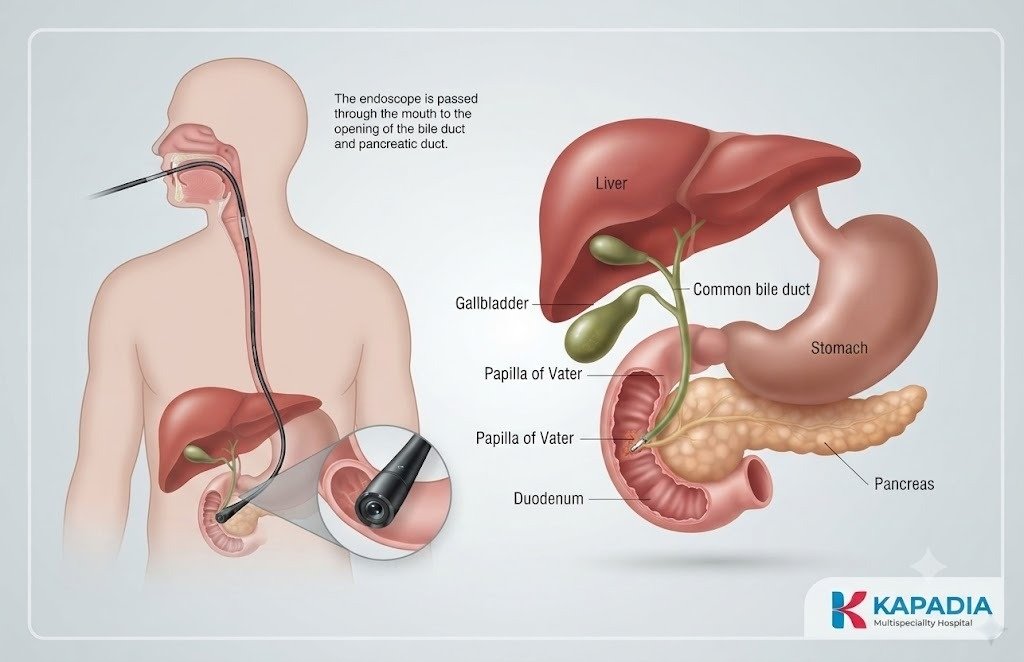
Endoscopic Retrograde Cholangiopancreatography (ERCP) is a procedure that uses endoscopy - a long, flexible, lighted tube along with fluoroscopy to diagnose and treat abnormalities within the liver, gallbladder, bile ducts, and pancreas.
What Is ERCP?
Endoscopic Retrograde Cholangiopancreatography (ERCP) is a procedure that uses endoscopy - a long, flexible, lighted tube along with fluoroscopy to diagnose and treat abnormalities within the liver, gallbladder, bile ducts, and pancreas. It is primarily carried out by gastroenterologists who are highly skilled and specially qualified.
What Is The Use Of ERCP?
The ERCP procedure is used for both diagnostic and therapeutic purposes.
ERCP Procedure, Duration & Preparation
Before the procedure, the doctor will ask you about all your allergies, health history, prescribed medicines, and other supplements you have been taking regularly. You may be asked to briefly stop taking them by your doctor.
Procedure
Before the procedure, the doctor will ask you about all your allergies, health history, prescribed medicines, and other supplements you have been taking regularly. You may be asked to briefly stop taking them by your doctor.
During an ERCP, you will be sedated with an intravenous (IV) needle into your arms to help you relax and be comfortable. Your vitals will be monitored by the medical professionals.
The doctor will either spray anesthesia on the back of your throat or give you a liquid anesthetic to gargle. You may be given general anesthesia in some instances depending on your choice and discussion with the doctor.
The doctor will carefully feed the endoscope down your esophagus, through your stomach, and into your duodenum on the examining table. A video image will be sent to a monitor from a small camera attached to the endoscope. Air is pumped into your stomach and duodenum through the endoscope, making them easier to see. X-ray views will be acquired from various angles.
The tiny tube for dye injection will be moved to the pancreatic duct after X-rays of the biliary system are taken. X-rays will be taken after a contrast dye is injected into the pancreatic duct. While the X-rays are being taken, you may be requested to change positions once again
Time Taken For The Procedure
ERCP can take anywhere from 30 minutes to 2 hours. You will need to stay in the hospital for 1 to 2 hours after the surgery until the sedative wears off. Before you are discharged from the hospital, the doctor will check and make sure you don't have any signs of complications.
You may need to stay in the hospital overnight if any treatment is performed during the ERCP, such as the removal of a gallstone.
Preparation
For the treatment to be accurate and safe, your stomach and duodenum must've been empty for 6 to 8 hours before the surgery. Also, the doctor will want to know whether you have any allergies, particularly to iodine, which is present in the dye. You'll also need to make arrangements for someone to drive you home.
Frequently Asked Questions.
Quick answers about ERCP at Kapadia Multispeciality Hospital, Goregaon West.
Endoscopic Retrograde Cholangiopancreatography (ERCP) is a procedure that uses endoscopy - a long, flexible, lighted tube along with fluoroscopy to diagnose and treat abnormalities within the liver, gallbladder, bile ducts, and pancreas. It is primarily carried out by gastroenterologists who are highly skilled and specially qualified.
The ERCP procedure is used for both diagnostic and therapeutic purposes.
Before the procedure, the doctor will ask you about all your allergies, health history, prescribed medicines, and other supplements you have been taking regularly. You may be asked to briefly stop taking them by your doctor. During an ERCP, you will be sedated with an intravenous (IV) needle into your arms to help you relax and be comfortable. Your vitals will be monitored by the medical professionals.
ERCP can take anywhere from 30 minutes to 2 hours. You will need to stay in the hospital for 1 to 2 hours after the surgery until the sedative wears off. Before you are discharged from the hospital, the doctor will check and make sure you don't have any signs of complications. You may need to stay in the hospital overnight if any treatment is performed during the ERCP, such as the removal of a gallstone.
For the treatment to be accurate and safe, your stomach and duodenum must've been empty for 6 to 8 hours before the surgery. Also, the doctor will want to know whether you have any allergies, particularly to iodine, which is present in the dye. You'll also need to make arrangements for someone to drive you home.
ERCP (Endoscopic Retrograde Cholangio-Pancreatography) is used to diagnose and treat problems of the bile ducts and pancreas - see the full list of conditions above that our specialists evaluate and treat with ERCP.
ERCP is performed under sedation, so you should not feel pain during the procedure. Some patients experience mild bloating or a sore throat afterwards, which settles quickly.
ERCP is usually a short-stay procedure. Depending on the findings and whether a therapeutic step was performed, your doctor will advise same-day discharge or brief observation at the hospital.
Related Treatments.
Explore related treatments handled by our senior specialist team at Kapadia Hospital.
Diagnostic & therapeutic endoscopy.
Know more about treatment GastroscopyUpper GI endoscopy for stomach and food pipe.
Know more about treatment ColonoscopyDiagnostic scope of the colon and large intestine.
Know more about treatment Circumcision (ZSR)Painless day-care circumcision surgery.
Know more about treatment Hernia SurgeryLaparoscopic & open mesh repair for hernia.
Know more about treatment GallstonesLaparoscopic keyhole removal of gallstones.
Know more about treatment AppendixKeyhole appendix removal (appendectomy).
Know more about treatment LaparoscopyKeyhole surgery with faster recovery.
Know more about treatment