
Femoral Hernia Surgery
in Mumbai, India.
Experiencing a bulge or pain in your groin, particularly near the crease of your thigh? It could be a femoral hernia, a protrusion of abdominal tissue through a weak spot in the femoral canal. Femoral hernias are less common than inguinal hernias, but they can be more serious, especially in women.
About Femoral Hernia.
A femoral hernia is a relatively uncommon type of hernia. A femoral hernia is a protrusion of an intestine loop through a weak abdominal wall in the lower abdomen near the thigh or groin. Depending on the severity of the condition, it may require emergency surgery, i.e. Femoral Hernia Surgery. Whether obstructed, incarcerated or strangulated hernia, repair the hernia at Kapadia Multispeciality Hospital before it turns out to be life threatening.
At Kapadia Multispeciality Hospital, we understand the importance of timely and effective treatment for femoral hernias. Our team of highly skilled femoral hernias surgeons in Mumbai utilizes advanced techniques and a patient-centered approach to ensure optimal outcomes. Don't let a femoral hernia limit your mobility or quality of life. Schedule a consultation with a hernia specialist at Kapadia Multispeciality Hospital today.
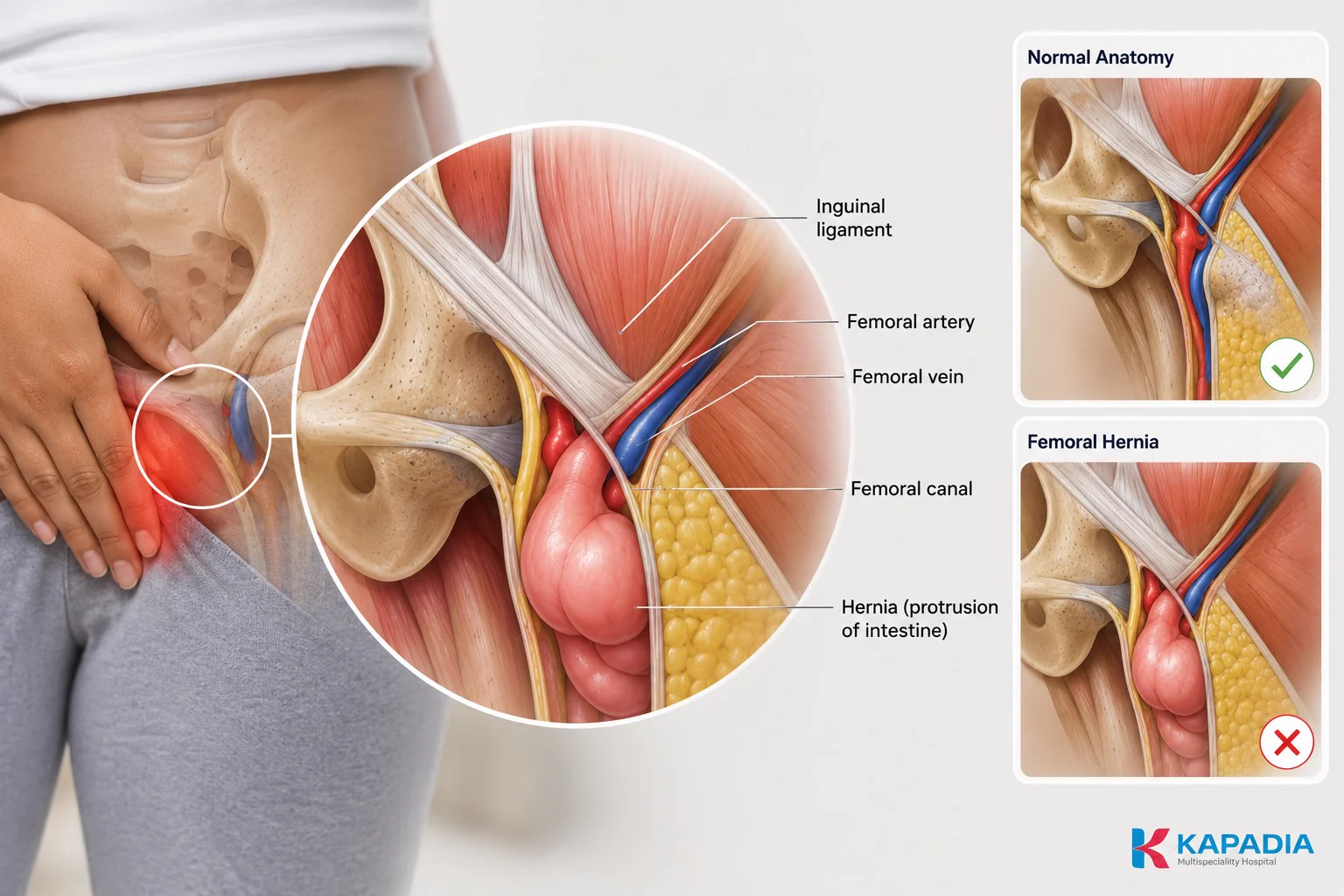
Types Of Femoral hernia.
Incarcerated femoral hernia
An incarcerated femoral hernia is one that has been stuck in the femoral canal and is unable to be moved back into the abdomen. This sort of hernia is also referred to as "irreducible." An obstructed femoral hernia arises when a section of the intestine becomes entangled with the hernia, obstructing the intestine.
Obstructed femoral hernia
An obstructed femoral hernia develops when a section of the intestine becomes entangled with the hernia, obstructing the intestine. The obstruction may worsen, causing the hernia to become more uncomfortable.
Strangulated femoral hernia
A strangulated femoral hernia develops when the hernia blocks up the blood supply to a section of the colon, causing the loop of the bowel to die. Strangulation can occur in any hernia, but it is more common in femoral and inguinal hernias because their "necks" are narrower.
Femoral Hernia Causes.
Internal tissues push through weak spots in the muscular wall at the pelvis or inner thigh, causing a femoral hernia. It's possible that the specific cause is unknown. A person's muscle wall in the area may have been structurally weak from birth. Femoral hernias can also be caused by strain or excessive pressure as a result of:
Femoral Hernia Symptoms.
In a few cases one may not even realize that they are suffering from a femoral hernia. Small-sized hernias may not even cause any symptoms. The bulge of a small femoral hernia is not even noticeable at times. Large hernia causes a lot of discomfort and is more noticeable near the upper thigh area. While standing up the pain worsens and when heavy weight objects are lifted. As femoral hernia is located closely to the hip bone resulting in hip pain too. Some of the severe symptoms can be:
Femoral Hernia Treatment in Mumbai, India.
Small, asymptomatic femoral hernias may not necessitate medical attention. Doctors may keep an eye on your condition to see if your symptoms worsen. Surgical treatment is required for moderate to large femoral hernias, especially if they are causing any discomfort. There are two types of femoral hernia surgery - Open surgery and Laparoscopic surgery.
Open Surgery
Local / general anaesthesiaThis usually entails local anesthesia, which puts the patient to sleep during the surgical procedure. In some basic circumstances, however, the team may administer a topical anaesthetic. The area becomes numb, but the person remains conscious. To reach the hernia, the surgeon makes a small incision in the groin. The bulging tissue is then moved back into the abdomen before the femoral canal wall is repaired with strong stitches or a piece of mesh.
Laparoscopic Surgery
Minimally invasiveThis procedure is less painful. The patient is given general anaesthesia. The surgeon first creates multiple small incisions in the lower belly and inserts a laparoscope, a thin, tube-like equipment with a camera, into the incisions. The bulging tissue is then moved back into the abdomen, and the weakening muscle is repaired with mesh. Laparoscopic surgery is not recommended to everyone, particularly those with big hernias. People who have this procedure have a faster recovery time and fewer scarring than those who have open surgery.