
Meniscus Tear
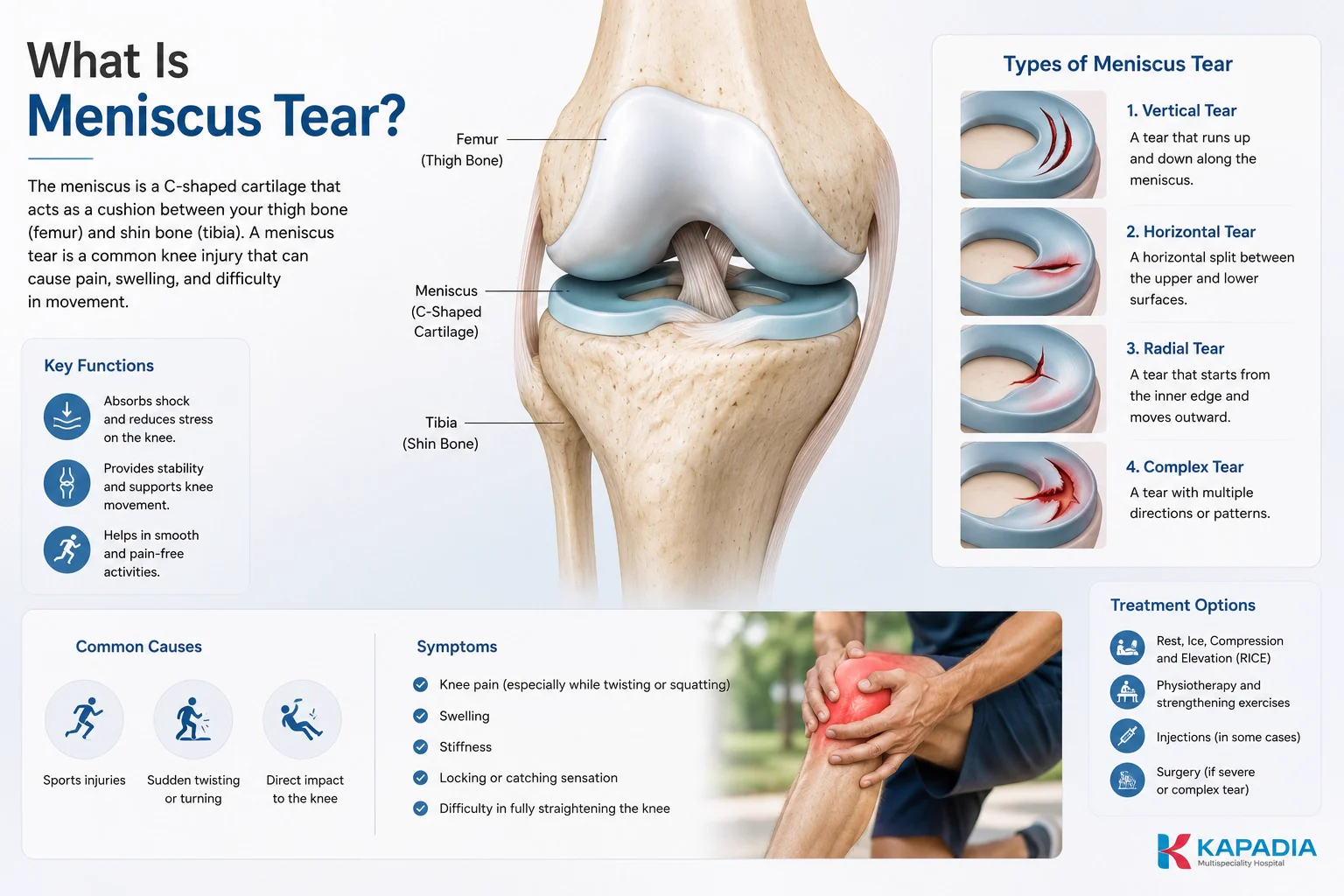
Two pieces of meniscus (types of cartilage) lie between your thighbone (femur) and shinbone (tibia) in your knee. There are two sets of meniscus in the knee: lateral and medial meniscus, which function as elastic cartilage wedges and shock absorbers, cushioning your bones and knee joint.
What Is Meniscus Tear?
Two pieces of meniscus (types of cartilage) lie between your thighbone (femur) and shinbone (tibia) in your knee. There are two sets of meniscus in the knee: lateral and medial meniscus, which function as elastic cartilage wedges and shock absorbers, cushioning your bones and knee joint. The cartilage in your knees wears down and becomes weaker as you get older. A meniscus tear can also be caused by arthritis (the breakdown of cartilage in the joints). A torn meniscus in the knee is a very common injury. Meniscus tears are common among athletes.
Causes & Diagnosis
A torn meniscus can be caused by any activity that causes you to twist or rotate your knee violently, such as aggressive pivoting or fast stops and turns while your foot remains planted on the ground. Kneeling, squatting deeply, or lifting something heavy can all cause a torn meniscus.
Causes of Meniscus Tear
A torn meniscus can be caused by any activity that causes you to twist or rotate your knee violently, such as aggressive pivoting or fast stops and turns while your foot remains planted on the ground. Kneeling, squatting deeply, or lifting something heavy can all cause a torn meniscus.
Degenerative changes in the knee can cause a torn meniscus in older persons with little or no trauma.
When you're playing sports, you're more likely to have a tear. A simple motion such as stepping on an uneven surface can tear a meniscus in those whose cartilage has worn down (due to ageing or arthritis). Even if there is no injury to the knee, deterioration from arthritis can cause a tear.
Diagnosis
- Physical Examination: The doctor will check the knee and measure the range of motion once he has discussed symptoms. A McMurray test may be used by the doctor to check for a meniscal tear. This test entails bending, straightening, and rotating your knee. During this test, a tiny pop can be heard. This could be a sign of a meniscus tear.
- MRI: A magnetic field is used to acquire several images of your knee during an MRI. An MRI can acquire photos of cartilage and ligaments to see if a meniscus tear is present.
- Ultrasound: An ultrasound is a type of imaging procedure that uses sound waves to create images inside the body. This will detect if you have any loose cartilage in your knee that is getting caught.
- Arthroscopy: If the doctor fails to identify the source of knee pain from the above mentioned methods, he may recommend arthroscopy to examine your knee.
Symptoms
If your meniscus is torn, it may take up to 24 hours for pain and swelling to appear, especially if the tear is minimal. The following indications and symptoms may appear in your knee:
Meniscus Tear Treatment Options
The treatment would be determined by a number of criteria, including the patient's age, the severity of the injury, his or her health and medical history and how much pain tolerance an individual has.
How it is treated?
The treatment would be determined by a number of criteria, including the patient's age, the severity of the injury, his or her health and medical history and how much pain tolerance an individual has.
Initially, the doctor would suggest you to use conservative methods to treat the knee injury, such as:
- Allow your knee to rest. Crutches should be used to avoid putting any weight on the joint.
- Ice your knee for 20-30 minutes every few hours.
- To minimize inflammation, compress the knee or wrap it in an elastic bandage.
- To decrease swelling, elevate your knee.
Physical therapy
Physical therapy to strengthen the muscles around your knee may be recommended by the doctor. Physical therapy can help you relieve discomfort and improve the mobility and stability of your knees. Massage techniques may also be used by your physical therapist to help reduce stiffness and swelling.
Surgery
If the knee hasn't responded well to conservative treatments and physical therapy, surgery is another possibility. Meniscal tears are frequently treated using knee arthroscopy, a minimally invasive procedure. A small, illuminated optic tube (arthroscopy) is placed through a small incision in the joint during an arthroscopy. The provider can then repair or trim out the damaged area of the meniscus by projecting images of the inside of the knee onto a screen. The preservation of as much of the meniscus as feasible is critical for young patients' knee health. Sutures are used to hold the meniscus together while the body heals the place after it has been repaired. Meniscal tears in children treated with arthroscopy recover faster than those treated with other methods. You will find the best surgical procedures and skilled specialists with significant competence at Mumbai's Kapadia Hospital.
Frequently Asked Questions.
Quick answers about Meniscus Injury at Kapadia Multispeciality Hospital, Goregaon West.
Two pieces of meniscus (types of cartilage) lie between your thighbone (femur) and shinbone (tibia) in your knee. There are two sets of meniscus in the knee: lateral and medial meniscus, which function as elastic cartilage wedges and shock absorbers, cushioning your bones and knee joint. The cartilage in your knees wears down and becomes weaker as you get older. A meniscus tear can also be caused by arthritis (the breakdown of cartilage in the joints). A torn meniscus in the knee is a very common injury. Meniscus tears are common among athletes.
A torn meniscus can be caused by any activity that causes you to twist or rotate your knee violently, such as aggressive pivoting or fast stops and turns while your foot remains planted on the ground. Kneeling, squatting deeply, or lifting something heavy can all cause a torn meniscus. Degenerative changes in the knee can cause a torn meniscus in older persons with little or no trauma.
If your meniscus is torn, it may take up to 24 hours for pain and swelling to appear, especially if the tear is minimal. The following indications and symptoms may appear in your knee:
The treatment would be determined by a number of criteria, including the patient's age, the severity of the injury, his or her health and medical history and how much pain tolerance an individual has. Initially, the doctor would suggest you to use conservative methods to treat the knee injury, such as:
Physical therapy to strengthen the muscles around your knee may be recommended by the doctor. Physical therapy can help you relieve discomfort and improve the mobility and stability of your knees. Massage techniques may also be used by your physical therapist to help reduce stiffness and swelling.
If the knee hasn't responded well to conservative treatments and physical therapy, surgery is another possibility. Meniscal tears are frequently treated using knee arthroscopy, a minimally invasive procedure. A small, illuminated optic tube (arthroscopy) is placed through a small incision in the joint during an arthroscopy. The provider can then repair or trim out the damaged area of the meniscus by projecting images of the inside of the knee onto a screen. The preservation of as much of the meniscus as feasible is critical for young patients' knee health. Sutures are used to hold the meniscus together while the body heals the place after it has been repaired. Meniscal tears in children treated with arthroscopy recover faster than those treated with other methods. You will find the best surgical procedures and skilled specialists with significant competence at Mumbai's Kapadia Hospital.
Related Treatments.
Explore related treatments handled by our senior specialist team at Kapadia Hospital.
Minimally invasive keyhole joint surgery.
Know more about treatment ACL / PCL RepairArthroscopic knee ligament reconstruction.
Know more about treatment Ligament InjuriesDiagnosis & repair of knee ligament injuries.
Know more about treatment MPFL ReconstructionRepair for recurrent kneecap dislocation.
Know more about treatment Shoulder DislocationCare for recurrent shoulder dislocation.
Know more about treatment Rotator Cuff RepairArthroscopic rotator cuff tear repair.
Know more about treatment Frozen ShoulderTreatment to restore shoulder movement.
Know more about treatment Sports InjuryComplete sports-injury diagnosis & care.
Know more about treatment