
Ligament Tear
Ligaments are strong, flexible tissue bands that links bones all across the body. They allow bones to move by providing mobility between them. Ligament tears are commonly caused by twisting body parts or landings that are awkward.
Ligament Tear
Ligaments are strong, flexible tissue bands that links bones all across the body. They allow bones to move by providing mobility between them. Ligament tears are commonly caused by twisting body parts or landings that are awkward. When the fibrous tissue of a ligament, tendon, or muscle is ruptured, a ligament tear occurs.
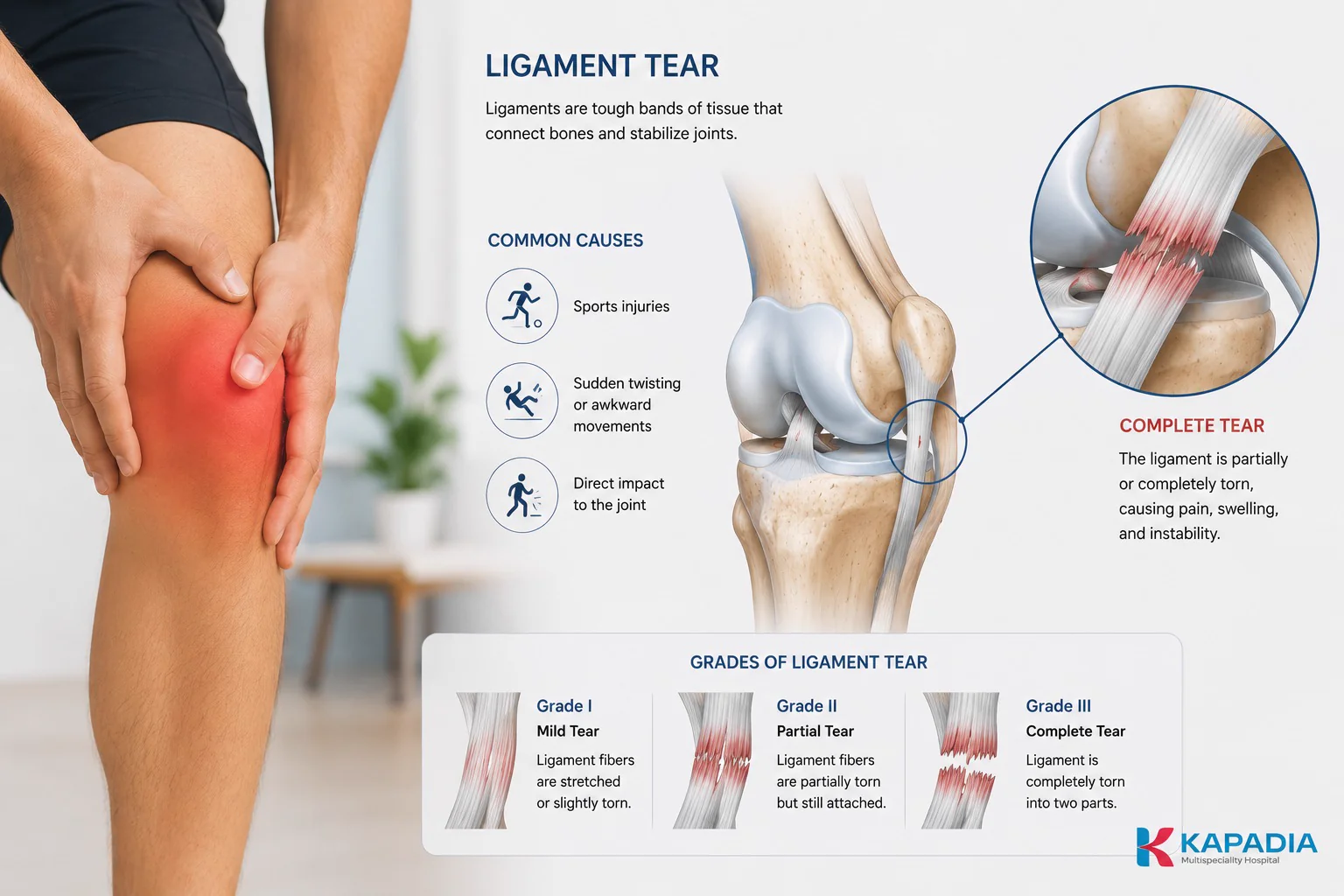
Mild ligament tear
The damaged ligament is stretched, but the joint remains stable.
Moderate ligament tear
The ligament is partially torn, it has not yet fully detached from the bone. As a result, the joint becomes unstable.
Total Ligament tear
The torn ligament has been completely torn from the bone.
What Are the Symptoms of a Ligament Tear?
Torn ligament symptoms vary depending up on the severity of an injury, and may include:
Diagnosis & Treatment
A physical examination is carried out to diagnose a ligament tear. Your doctor will inquire about the activity you were doing that caused the injury. They can learn more about the degree of the injury with a magnetic resonance imaging (MRI) scan can be suggested to determine if a ligament tear is partial or complete.
Diagnosis
A physical examination is carried out to diagnose a ligament tear. Your doctor will inquire about the activity you were doing that caused the injury. They can learn more about the degree of the injury with a magnetic resonance imaging (MRI) scan can be suggested to determine if a ligament tear is partial or complete.
Treatment
The initial treatment for a ligament injury is R.I.C.E. (rest, ice, compression, and elevation).
- Rest: You must refrain from engaging in any activity that puts additional strain on the affected joint. Giving it time to heal.
- Ice: Using an ice pack to relieve pain and reduce swelling.
- Compression: Using an elastic bandage to wrap over the wounded area helps to minimize and limit overall edema.
- Elevation: Raising the injured body area decreases swelling and helps to manage blood flow.
Surgical Treatment
The doctor might recommend a surgery to repair the ligament in the case of significant strains or tears. Ligament surgery may involve the repair or replacement of the ligament. A tendon graft may be required to keep the injured joint together.
The doctor will recommend physical therapy (physiotherapy) after surgery to help stabilize the joint and enhance mobility.
Consult a specialist at Mumbai's Kapadia Hospital, which has cutting-edge surgical technology and highly qualified specialists to help you recover from ligament tears and injuries.
Frequently Asked Questions.
Quick answers about Ligament Injuries at Kapadia Multispeciality Hospital, Goregaon West.
Ligaments are strong, flexible tissue bands that links bones all across the body. They allow bones to move by providing mobility between them. Ligament tears are commonly caused by twisting body parts or landings that are awkward. When the fibrous tissue of a ligament, tendon, or muscle is ruptured, a ligament tear occurs.
There are three kinds of ligament tear:
Torn ligament symptoms vary depending up on the severity of an injury, and may include:
A physical examination is carried out to diagnose a ligament tear. Your doctor will inquire about the activity you were doing that caused the injury. They can learn more about the degree of the injury with a magnetic resonance imaging (MRI) scan can be suggested to determine if a ligament tear is partial or complete.
The initial treatment for a ligament injury is R.I.C.E. (rest, ice, compression, and elevation). The doctor might recommend a surgery to repair the ligament in the case of significant strains or tears. Ligament surgery may involve the repair or replacement of the ligament. A tendon graft may be required to keep the injured joint together.
Related Treatments.
Explore related treatments handled by our senior specialist team at Kapadia Hospital.
Minimally invasive keyhole joint surgery.
Know more about treatment ACL / PCL RepairArthroscopic knee ligament reconstruction.
Know more about treatment Meniscus InjuryArthroscopic treatment for meniscus tears.
Know more about treatment MPFL ReconstructionRepair for recurrent kneecap dislocation.
Know more about treatment Shoulder DislocationCare for recurrent shoulder dislocation.
Know more about treatment Rotator Cuff RepairArthroscopic rotator cuff tear repair.
Know more about treatment Frozen ShoulderTreatment to restore shoulder movement.
Know more about treatment Sports InjuryComplete sports-injury diagnosis & care.
Know more about treatment