
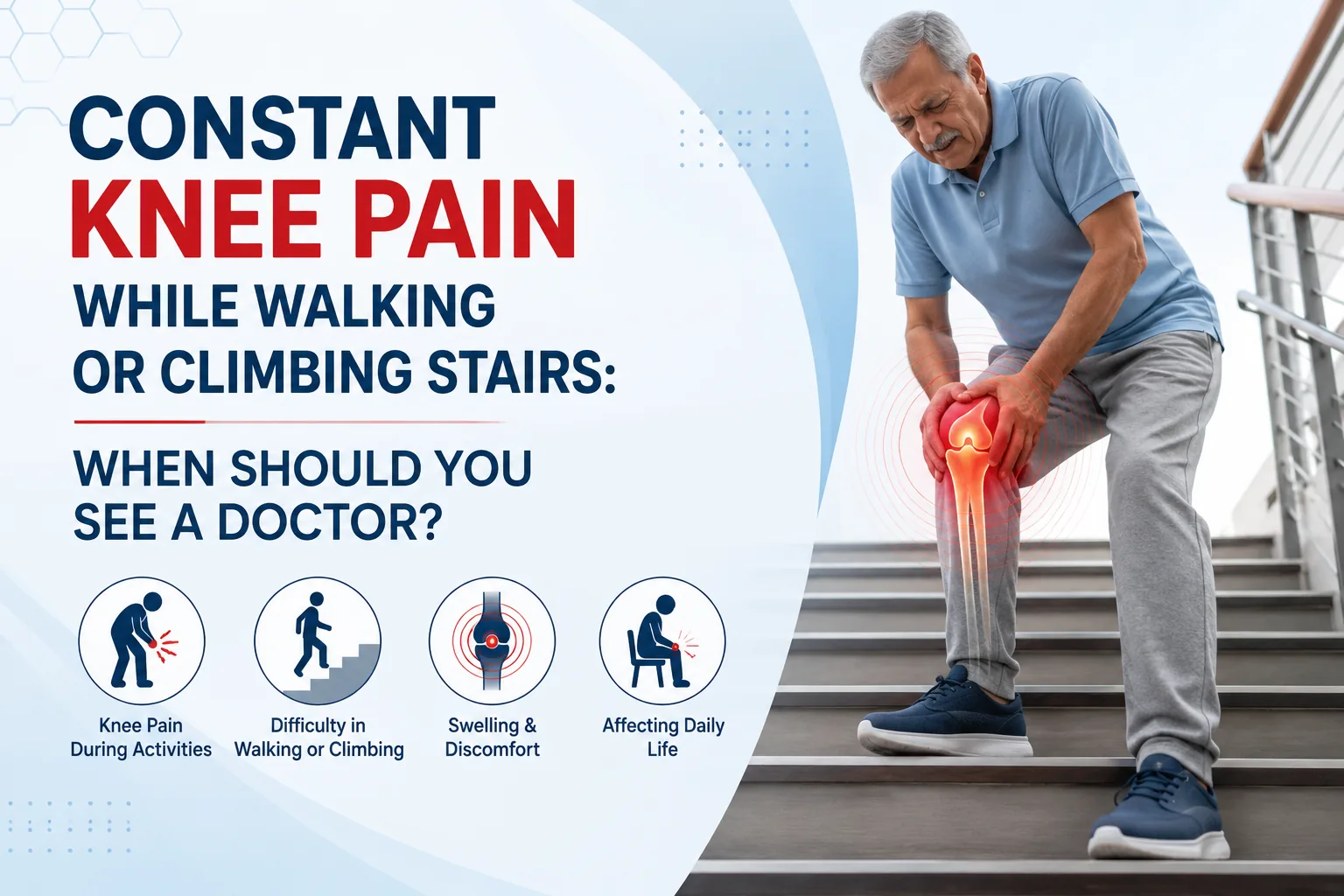
Walking, standing up from a chair and climbing stairs place regular pressure on the knee joint. Occasional mild discomfort after unusual activity may settle with rest. However, constant pain in knee movement should not be ignored, especially when it affects sleep, work, balance or independence.
Knee pain is not a single disease. It may come from cartilage, bone, ligaments, tendons, muscles, the kneecap or the soft tissues around the joint. Age, previous injuries, body weight, activity level and medical conditions can all influence the problem.
Understanding constant knee pain causes helps patients know when home care may be enough and when an orthopaedic examination is needed. Early assessment can identify treatable problems before pain and stiffness become more limiting.
Why Does the Knee Hurt While Walking or Climbing Stairs?
The knee supports body weight and bends repeatedly during walking. Climbing stairs places greater demand on the muscles and increases pressure between the kneecap and the thigh bone. Pain during these activities may appear when cartilage is worn, the kneecap does not move smoothly, a tendon is irritated, or the muscles supporting the joint are weak.
The location of pain can provide clues. Pain at the front of the knee may relate to the kneecap. Pain on the inner or outer side may involve the joint space, meniscus, ligaments or bursae. Pain behind the knee may be linked to swelling, a cyst, tendon problems or other conditions. Only an examination can confirm the cause.
Common Constant Knee Pain Causes
Some of the most frequent causes include:
- Knee osteoarthritis: The protective cartilage gradually wears down, leading to pain, stiffness, swelling and difficulty walking or climbing stairs.
- Patellofemoral pain: Irritation around the kneecap can cause front knee pain during stairs, squats, running or after sitting for a long time.
- Meniscus damage: The meniscus is a cushion inside the knee. Age-related wear or a twisting injury may cause pain, swelling, catching or locking.
- Ligament injury: An injury to the ACL, PCL, MCL or LCL can cause pain, instability or a feeling that the knee may give way.
- Tendon or bursa inflammation: Overuse can irritate a tendon or a small fluid-filled bursa. Pain may become worse with exercise or stairs.
- Muscle weakness or poor movement pattern: Weak thigh and hip muscles may increase stress on the knee during daily movement.
- Rheumatoid or inflammatory arthritis: Inflammation can affect both knees and may cause prolonged morning stiffness, warmth and swelling.
- Previous fracture, surgery or sports injury: Earlier damage can change joint movement and increase the risk of later pain or arthritis.
- Referred pain: Hip, lower-back or nerve problems can sometimes be felt around the knee.
Warning Signs That Need Prompt Medical Attention
Some knee symptoms should be assessed quickly rather than managed only with home remedies.
- Severe pain after a fall, twist or direct injury
- Inability to stand, walk or put weight on the leg
- A knee that looks deformed or suddenly becomes very swollen
- A popping sound followed by instability or loss of movement
- The knee locks and cannot fully bend or straighten
- Redness, marked warmth, fever or feeling unwell
- Calf swelling, chest pain or breathlessness
- Loss of sensation, weakness or a cold foot
When Should You See a Doctor for Constant Knee Pain?
Book an orthopaedic consultation when the pain lasts more than a few days, keeps returning, becomes worse, or affects normal activities. You should also seek advice when knee pain climbing stairs is accompanied by swelling, stiffness, grinding, instability or reduced movement.
Pain that wakes you at night, continues while resting, or makes you use a cane or support should be evaluated. Older adults should not assume that knee pain is simply part of ageing. Many causes can be treated with exercise therapy, medicines, injections, weight management or surgery when needed.
How Is the Cause Diagnosed?
The doctor begins by asking when the pain started, where it is located, what movements make it worse and whether there was an injury. Information about swelling, locking, instability, morning stiffness and other health conditions is also important.
During the examination, the doctor checks walking pattern, alignment, swelling, tenderness, movement, muscle strength and joint stability. An X-ray may show arthritis, reduced joint space, bone changes or a fracture. Ultrasound or MRI may be advised when a tendon, ligament, meniscus or another soft tissue is suspected. Blood tests are used only when infection, gout or inflammatory arthritis is a possibility.
What Treatments May Help?
Treatment depends on the diagnosis, age, severity and impact on daily life. Surgery is not the first step for every patient.
- Activity changes and short periods of rest from movements that worsen pain
- Ice for swelling after activity or heat for stiffness, as advised
- Prescribed pain relief or anti-inflammatory medicine when medically suitable
- Physiotherapy to improve knee movement and strengthen the thigh, hip and core muscles
- Weight management to reduce repeated load on the joint
- Supportive footwear, walking aids or a knee brace in selected cases
- Injections for selected patients after a medical assessment
- Treatment of an underlying inflammatory condition, gout or infection
- Surgery for serious injury, advanced meniscus damage or symptoms that do not improve with suitable non-surgical care
What Can You Do at Home Until the Appointment?
Reduce activities that clearly increase pain, but avoid complete bed rest unless advised. Gentle movement usually helps prevent stiffness. Use a handrail on stairs, take one step at a time and wear shoes with good grip. A cold pack wrapped in a cloth can be used for short periods when the knee is swollen.
Do not repeatedly take pain medicines without checking whether they are safe with your health conditions and other medicines. Avoid forceful massage, deep squats and high-impact exercise when the cause of pain is unknown. If the knee becomes more swollen, unstable or painful, seek medical care sooner.
When Is Knee Replacement Considered?
Knee replacement may be discussed when severe arthritis causes long-term pain and stiffness that limit walking, climbing stairs, getting up from a chair or sleeping, and when suitable non-surgical treatments no longer provide enough relief.
The decision is based on symptoms, examination, X-rays, general health and personal goals. Robotic-assisted knee replacement is one surgical option that helps the surgeon plan bone preparation and implant positioning with technology. The robot does not operate independently; the orthopaedic surgeon remains in control.
Why Choose Kapadia Multispeciality Hospital for Knee Pain Treatment in Mumbai?
Kapadia Multispeciality Hospital in Goregaon West provides orthopaedic evaluation and treatment for patients with constant knee pain, arthritis and mobility problems. The care pathway can include examination, imaging, medicines, physiotherapy advice and surgical assessment when required.
For patients with advanced joint damage, the hospital also offers knee replacement and robotic-assisted knee replacement services. Treatment should always be based on the patient's diagnosis and needs rather than on pain alone.
Key highlights include:
- Assessment by orthopaedic specialists for knee pain and arthritis
- Diagnosis supported by clinical examination and appropriate imaging
- Non-surgical treatment planning before surgery is considered
- Physiotherapy and rehabilitation support for mobility and strength
- Conventional and robotic-assisted knee replacement options for suitable patients
- Accessible care in Goregaon West for patients seeking knee pain treatment in Mumbai
Conclusion
Constant pain in knee movement can come from arthritis, kneecap problems, tendon irritation, meniscus damage, injury or several other causes. Pain while walking or climbing stairs is a sign that the joint or its supporting muscles are under stress.
Seek medical advice when pain continues, affects everyday activity or appears with swelling, stiffness, locking or instability. Urgent care is needed after a serious injury, when you cannot bear weight, or when the knee is red and hot with fever. Patients can consult the orthopaedic team at Kapadia Multispeciality Hospital for diagnosis and an individual treatment plan.
Frequently Asked Questions
Is knee pain while climbing stairs always arthritis?
No. Arthritis is common, but pain on stairs may also come from patellofemoral pain, tendon irritation, bursitis, meniscus problems or muscle weakness. An examination is needed when the pain continues.
Why does my knee hurt more while going down stairs?
Going down stairs requires the thigh muscles to control the body slowly and can increase pressure around the kneecap. Pain may be linked to kneecap irritation, arthritis or weakness in the supporting muscles.
Can constant knee pain improve without surgery?
Yes. Many patients improve with physiotherapy, activity changes, weight management, medicines or other non-surgical treatments. Surgery is considered when the cause is severe or symptoms remain limiting despite proper care.
Should I exercise when my knee hurts?
Complete inactivity can increase stiffness and weakness, but painful or high-impact exercise should be avoided. A doctor or physiotherapist can recommend safe exercises after identifying the cause.
Which test is best for constant knee pain?
There is no single test for every patient. X-rays are useful for arthritis and bone problems. MRI may be advised for ligaments, cartilage or meniscus problems. The doctor selects tests after examining the knee.
When does knee pain become an emergency?
Seek urgent care when you cannot bear weight, the knee is deformed, swelling is sudden and severe, the joint is red and hot with fever, or there is calf swelling, chest pain or breathing difficulty.
This article is for general awareness only. It does not replace a consultation, examination, diagnosis or treatment by a qualified doctor.